
The Topkapı Palace Harem: Life Inside the Sultan's Household
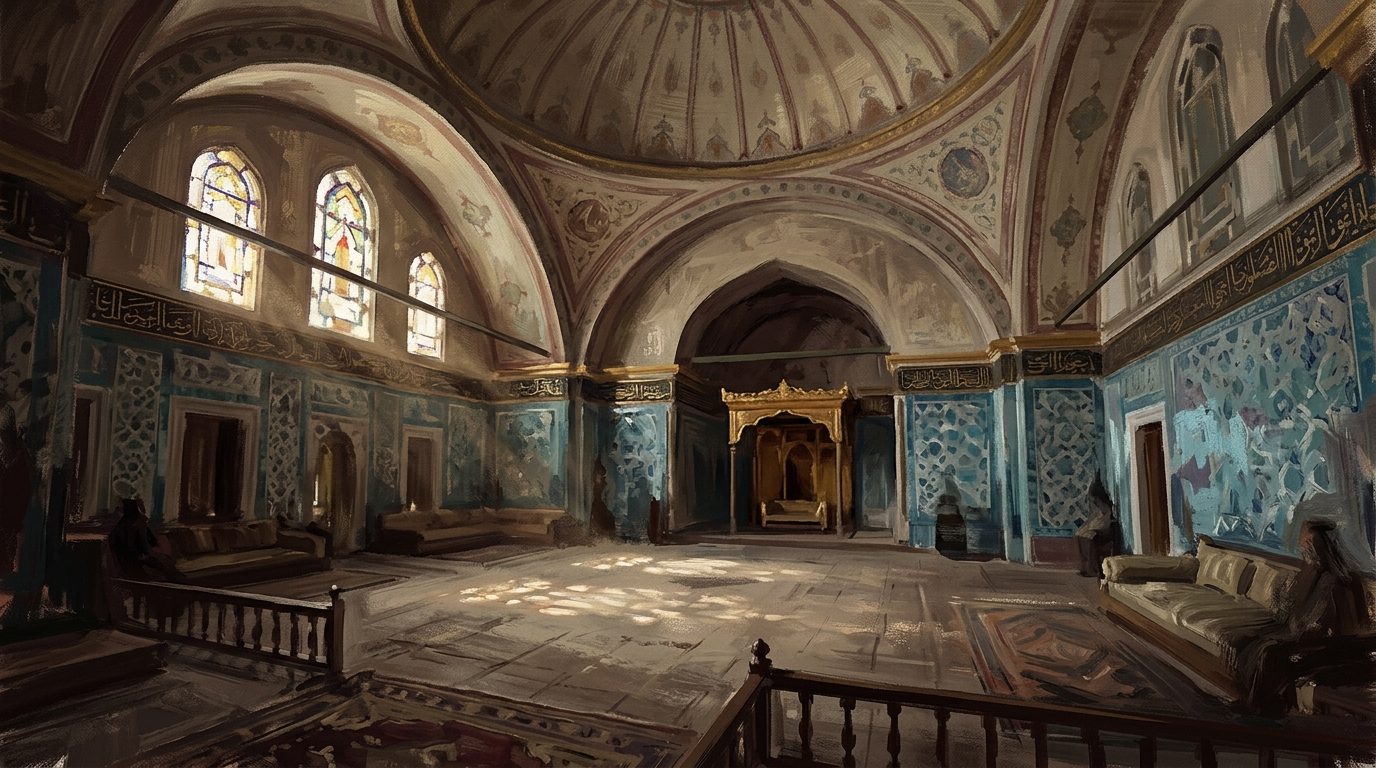
The Topkapı Palace Harem was the private household of the Ottoman dynasty: a walled city-within-a-palace of around 300 rooms, where the sultan’s mother, his consorts, his children and the servants who ran their lives were bound into one of the strictest hierarchies of the early modern world. It was never the languid fantasy of Orientalist painting. It was a family home, a school, and for more than a century the true engine room of imperial politics.
What Was the Harem, Really?
The word comes from the Arabic harām, meaning both forbidden and sacred, and the two senses applied equally. This was the protected, private half of the palace, closed to all men except the sultan, his sons and the eunuchs who guarded its doors. Because almost no outsider ever saw it, nineteenth-century European painters filled the gap with silk, smoke and idleness. The reality was closer to a court within the court.
The Harem kept salary registers, ranks and promotion ladders. Young women entered as cariye, trainee members of the household, and were schooled in etiquette, music, embroidery, calligraphy and Qur’anic recitation. Most never met the sultan at all. Many were freed after years of service and married, with a dowry, to rising officials, a match brokered by the palace itself. In our reading of the sources, it resembled an elite finishing school welded to a dynastic nursery far more than anything in a Delacroix canvas.
Who Lived Behind the Carriage Gate?
At the summit stood the valide sultan, the sultan’s mother, with the largest apartments and the largest stipend in the entire palace. Beneath her came the haseki, the favoured consorts who had borne the sultan children, then a descending order of stewardesses, mistresses of ceremonies, wardrobe keepers and trainees. Princes spent their childhoods here too, raised among the women until they came of age.
Guarding every threshold were the black eunuchs, African-born servants whose commander, the chief harem eunuch, ranked among the most powerful men in the empire. He controlled all access to the sultan’s family and administered the charitable endowments of Mecca and Medina, a portfolio that made him wealthier than most viziers. Nothing entered or left the Harem, not a letter, not a jewel, without passing his men.
Why Do Historians Speak of a “Sultanate of Women”?
From the 1530s to the mid-seventeenth century, the women of this household stepped out of domestic life and into government. Hürrem Sultan broke every precedent when Süleyman the Magnificent freed and married her, making a former concubine the legal wife of the world’s most powerful ruler. Her successors went further. Kösem Sultan governed the empire outright as regent for a son and then a grandson, receiving viziers from behind a screen.
Their letters, endowments and mosque complexes survive across Istanbul, hard evidence of authority exercised from rooms most subjects believed were silent. The full story of these remarkable careers is told in our piece on Hürrem Sultan and the women of the Harem.
İznik Tiles and the Imperial Hall
The Harem you see today owes its splendour largely to Murad III, who moved his entire household here after his accession in 1574 and rebuilt on a grand scale. His privy chamber, finished in 1578 and attributed to the great architect Sinan, is sheathed floor to dome in İznik tiles from the workshops’ finest period, their coral red never successfully reproduced since. A bronze fireplace anchors one wall; opposite it, a marble fountain once ran constantly, its splash masking conversation from listening ears.
Close by lies the Imperial Hall, the largest domed space in the palace, where the sultan received his family beneath a canopied throne while musicians played from a screened gallery. The adjoining private quarters, often called the sultan’s bedroom, show how compact even an emperor’s intimate world could be: a gilded bed alcove wrapped in tile, scripture and lamplight. How these interiors fit into the palace’s wider design is explored in our guide to the architecture of Topkapı.
What Was the Golden Cage?
The Harem’s beauty had a dark twin. For 150 years, Ottoman law had permitted a new sultan to execute his brothers to prevent civil war. In the early seventeenth century that brutal custom gave way to something quieter: confinement. Princes were shut into a suite of shuttered apartments within the Harem, the kafes, remembered as the Golden Cage.
There they waited, sometimes for decades, to inherit a throne or to die forgotten. The results scarred the dynasty. Some emerged from the cage unfit to rule, haunted and suspicious; İbrahim, freed after twenty-two years, never recovered. The tiled walls that delighted ambassadors’ wives enclosed, a few metres away, the loneliest rooms in the empire.
What Survives Today?
Of the roughly 300 rooms, a single evocative sequence is open, running from the courtyard of the black eunuchs through the valide sultan’s apartments to the Imperial Hall and the chamber of Murad III. It is enough. Few interiors anywhere compress four centuries of intimacy, ambition and fear into so short a walk, and the texture of the lives lived here is traced further in our account of an Ottoman sultan’s daily life.
To walk those tiled corridors yourself, read how Harem entry works and whether your visit includes it.