
Ottoman Gardens of Topkapı Palace: Tulips, Terraces & Paradise
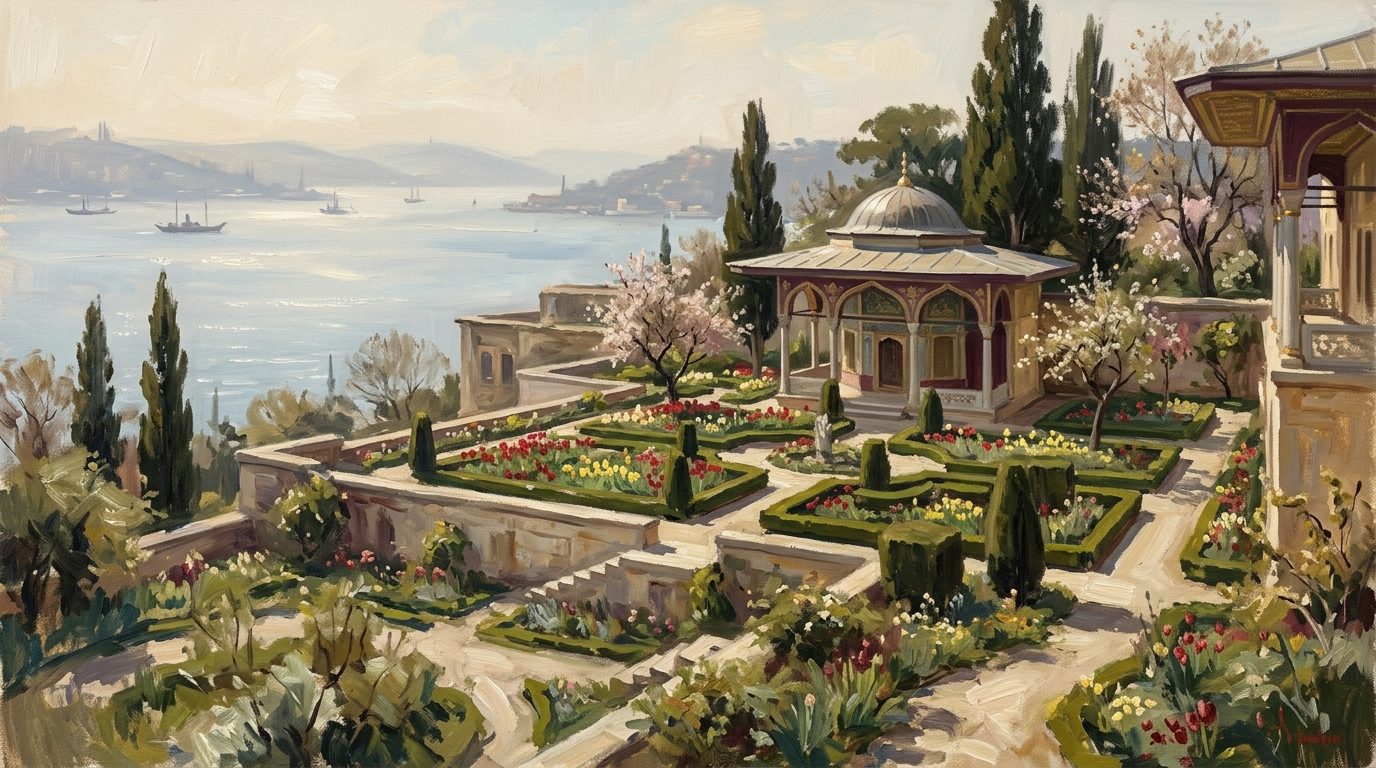
Long before Topkapı Palace was a museum, it was a garden. From the fifteenth century to the end of the empire, Ottoman gardens covered the whole of Seraglio Point: orchards, rose beds, terraces and pavilions arranged as an image of paradise on earth. What survives, from the Fourth Courtyard to Gülhane Park, still traces that vanished green world.
What Did a Garden Mean to the Ottomans?
For the Ottomans, a garden was a theological statement before it was an ornament. The Qur’an describes heaven as gardens beneath which rivers flow, and Turkish still uses a single image for both ideas: cennet, at once “garden” and “paradise”. A walled enclosure of running water, shade and fruit was a rehearsal for eternity, laid out in boxwood and marble.
That belief shaped Topkapı from its first stone. When Mehmed the Conqueror raised his New Palace on Seraglio Point in the 1460s, visitors described a vast garden with a palace set inside it, rather than the reverse. Nor did Ottoman gardeners share Europe’s later love of rigid geometry. Where Versailles would impose straight avenues on nature, the sultans preferred groves, informal beds and kiosks placed wherever the view was best.
The Outer Gardens: A Working Paradise
Paradise still had to earn its keep. The slopes falling away to the sea walls were productive ground: vegetable plots, vineyards, melon beds and orchards of figs, pomegranates and cherries. Surplus produce was sold at market, and the profits flowed quietly into the sultan’s privy purse.
The men who worked this land were the bostancıs, the corps of palace gardeners, several thousand strong at their height. Their duties went far beyond pruning. They guarded the shores, rowed the imperial barge and policed the grounds. They also held a darker office. The bostancıbaşı, the head gardener, oversaw executions within the palace, which made him one of the most quietly feared men in the empire. The hand that raised roses could also end a vizier’s career, and his life.
Terraces and Pavilions of the Fourth Courtyard
At the palace’s innermost edge, the garden turned purely to pleasure. The Fourth Courtyard is a stack of terraces overlooking the meeting of the Bosphorus and the Golden Horn, furnished with some of the finest garden buildings the empire ever produced. The Revan Kiosk of 1636 and the Baghdad Kiosk of 1639 commemorate Murad IV’s eastern campaigns, their interiors lined with İznik tiles and mother-of-pearl. Beside them, the gilded İftar Pergola caught the sunset breeze where sultans broke their Ramadan fast.
These buildings belong to a wider tradition explored in our guide to the palace’s architecture. In the garden, a kiosk was essentially a frame: a shaded room built to hold a view, a breeze and good conversation.
The Tulip Era: Festivals by Tortoise-Light
No flower is more Ottoman than the tulip, and no period more devoted to it than the Lâle Devri, the Tulip Era of Ahmed III’s reign in the early eighteenth century. Each spring the palace gardens staged night festivals of almost theatrical extravagance. Vases of rare blooms lined the terraces, caged songbirds sang from the branches, mirrors multiplied the lamplight, and tortoises wandered the beds with candles fixed to their shells, lighting the flowers from below.
The obsession had deep roots and a long reach. In the sixteenth century, bulbs travelled from Ottoman gardens to Vienna and on to Leiden, where they ignited the Dutch tulip mania of the 1630s. By Ahmed III’s day the trade had come full circle: prized Dutch varieties were imported back to Istanbul, their prices fixed by imperial decree. Which city, then, truly invented the cult of the tulip? The beds of Topkapı make a strong claim.
Roses, Fruit and the Business of Flowers
Flowers at Topkapı were provisions as much as decoration. The palace consumed rosewater and petals in remarkable quantities: for the sherbets, jams and sweets prepared in the imperial kitchens, for scenting fountains and linen, and for gifts of state. Orchard fruit went the same way, straight from the tree to the confectioner’s copper pans. The garden was, in effect, the first larder of the palace, and its gardeners answered to the kitchens almost as surely as to the throne.
How Did the Gardens Become Gülhane Park?
The name gives the story away. Gülhane means “house of roses”, after the rose gardens that filled this stretch of the outer grounds. The spot earned a place in political history in 1839, when the Gülhane Edict announcing the Tanzimat reforms was proclaimed here. As the empire faded, so did the gardens’ seclusion. In 1912 the city turned the outer grounds into a public park, and land reserved for sultans for four and a half centuries opened to anyone with an afternoon to spare.
Gülhane Park keeps the old associations alive. Every April its beds blaze with tulips for Istanbul’s spring plantings, an unintended echo of Ahmed III’s candlelit festivals a few metres up the hill.
The Harem’s Hidden Green World
For the women of the imperial Harem, the garden carried a different weight. Secluded by rank and custom, many rarely passed beyond the palace walls, so courtyards of boxwood, fountains and potted flowers were their whole share of the outdoors. A heavily escorted excursion to a garden pavilion counted among the great events of the year. The lives lived behind those walls, from anonymous consorts to the formidable Hürrem Sultan, are told in our histories of the Harem and of Hürrem and the women who shaped it.
The gardens of Topkapı are quieter now, but spring still finds them: tulips under the plane trees, roses against ancient walls, the same soft light falling on the same two seas. To walk these grounds yourself, see the palace with a guide, entry included.