
Sacred Relics of Topkapı Palace: Islam's Holiest Artifacts
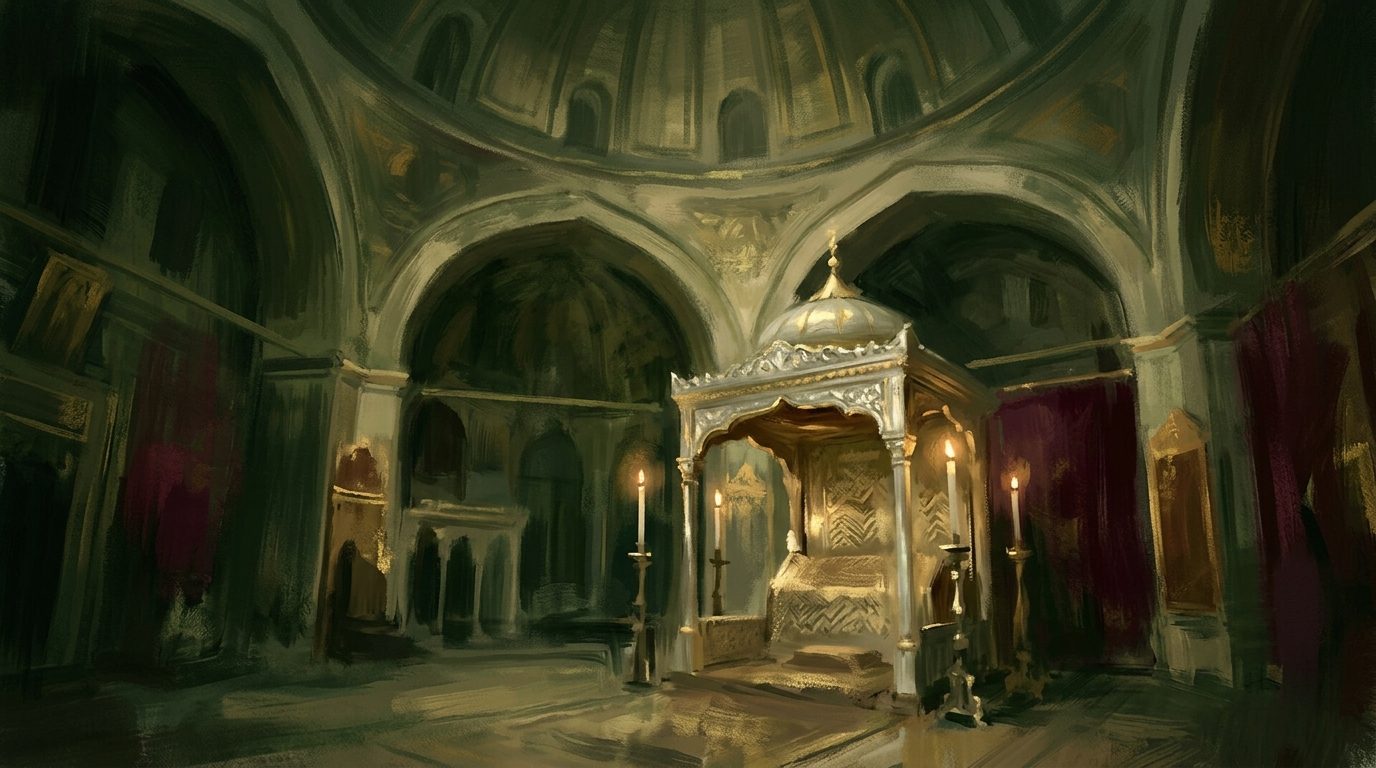
The most revered Islamic artifacts in existence are kept in the Chamber of Sacred Relics, the Kutsal Emanetler Dairesi, at Topkapı Palace in Istanbul. The collection holds the mantle, swords, seal and beard hairs of the Prophet Muhammad, together with objects attributed to earlier prophets, among them the staff of Moses. Most arrived in 1517, and the Qur’an has been recited beside them ever since.
What Is the Chamber of Sacred Relics?
The Chamber of Sacred Relics occupies the Privy Chamber, the Has Oda, in the Third Courtyard: a suite of domed rooms that once formed the sultan’s most private apartments. Built for Mehmed II in the fifteenth century, the rooms were gradually surrendered to the relics themselves, until the sultans withdrew altogether and their innermost chambers became a shrine.
Step inside and the register changes. Light falls dimly on tiles of cobalt and turquoise, on silver lattices and gilded cases. Unlike the emeralds and ceremonial thrones of the Imperial Treasury nearby, these objects were never meant to dazzle. They were meant to be guarded, veiled and honoured, and the hushed, green-gold interiors, among the finest in the palace’s architecture, make that purpose plain.
How Did Islam’s Holiest Relics Come to Istanbul?
The turning point was 1517. Sultan Selim I defeated the Mamluk Sultanate and entered Cairo, and with that victory the guardianship of Mecca and Medina, together with the mantle of the caliphate, passed to the Ottoman house. Islamic relics gathered over centuries in Cairo and the holy cities began their journey north to Istanbul.
The transfer was never a single shipment. Sacred objects continued to arrive for generations, sent by the custodians of Mecca and Medina, surrendered by governors, or sought out by sultans who understood exactly what they meant. Each new relic strengthened the Ottoman claim to lead the Islamic world. To hold these things was to hold authority itself.
The Mantle of the Prophet and Its Ramadan Ceremony
The holiest object in the chamber is the Hırka-i Saâdet, the Mantle of Felicity. Tradition records that the Prophet Muhammad gave the cloak to the poet Ka’b ibn Zuhayr, whose verses had moved him. Today it rests folded inside a golden chest, itself wrapped and cased in further protective layers.
Once a year, on the fifteenth day of Ramadan, the palace performed its most solemn rite. The sultan, with his family and highest officials, entered the chamber to visit the mantle. It was never worn and hardly ever seen; the sultan touched it only through a veil. Cloths pressed to the relic, and vials of the rosewater used to cleanse its chest, were afterwards distributed as treasured blessings. For a household governed by ritual, as our account of a sultan’s daily life shows, no ceremony mattered more.
Swords, Seal and Letter: The Prophet’s Personal Relics
Around the mantle gathers a constellation of personal objects. There are swords attributed to the Prophet and to the first caliphs, their scabbards later enriched by Ottoman goldsmiths. There are hairs from his beard, each kept in its own glass reliquary, and a tooth said to have been broken at the Battle of Uhud.
Two pieces feel startlingly direct. One is the Prophet’s seal. The other is a letter written on leather, traditionally addressed to the Muqawqis, ruler of Egypt, inviting him to Islam. Whatever questions scholars raise about individual items, the collection as a whole preserves the material memory of Islam’s founding generation as almost nowhere else on earth.
The Standard Carried to War
Among the relics stands the Sancak-ı Şerif, the Noble Standard, a banner associated with the Prophet himself. Unlike its companions, it did not always stay in the palace. When the empire faced its gravest campaigns, the standard was ceremonially unfurled and carried out to the army, a declaration that the troops marched beneath the Prophet’s own flag.
Its power was as much moral as material. Soldiers rallied to it; oaths were sworn before it. When a campaign ended, the standard returned to the chamber with the same solemnity with which it had left, restored to the company of the mantle it had briefly represented in the field.
The Staff of Moses and Relics of Earlier Prophets
The chamber also honours prophets who came long before Muhammad. Here are the staff of Moses, the turban of Joseph, a sword of David and a stone cooking pot of Abraham. These attributions rest on tradition rather than documentation, and the palace has never pretended otherwise.
Does that lessen them? Not really. Each object has been venerated for centuries, and that devotion is itself a historical fact. The staff of Moses was treasured in Cairo long before it reached Istanbul. What the chamber preserves is not simply a set of objects but an unbroken chain of belief, handed carefully from one age to the next.
Why Has the Qur’an Never Fallen Silent Here?
Since the sixteenth century, the Qur’an has been recited in the Chamber of Sacred Relics day and night, without interruption. The practice is traced to Selim I, and hafızes, reciters who carry the entire Qur’an in memory, have sustained it ever since in rotating shifts, around the clock, for roughly five hundred years.
The recitation outlived the empire it served. When the palace became a museum in 1924, the voices continued, and visitors today still hear them threading through the rooms. It is the clearest reminder that these are not curios in cases. They remain objects of living devotion, and the chamber remains, in every sense that matters, a sacred place.
To stand quietly in these rooms yourself, see the palace with a guide, entry included.