
Hürrem Sultan & the Women Who Ran the Topkapı Harem
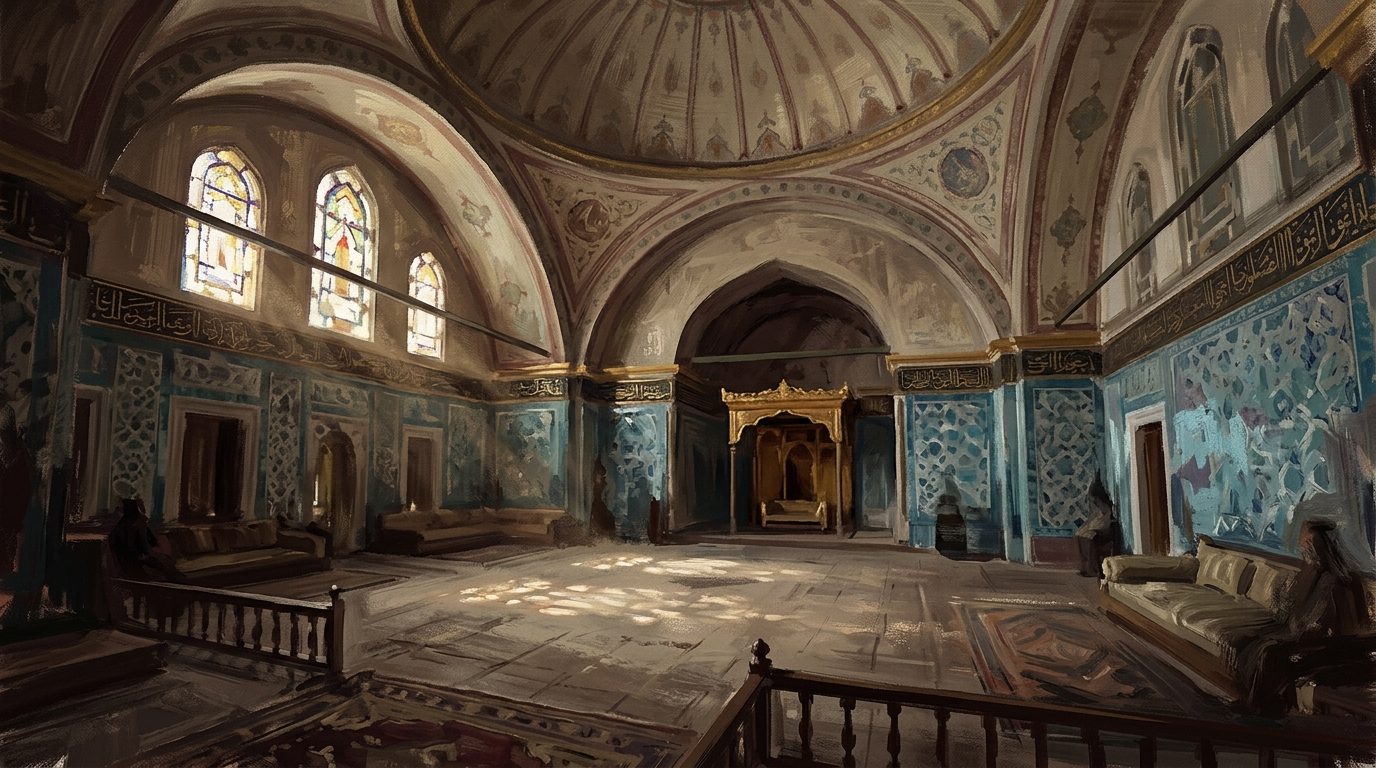
Hürrem Sultan, known in Europe as Roxelana, was a slave girl from Ruthenia, in modern Ukraine, who became the legal wife of Süleyman the Magnificent: something no concubine had achieved before her. From the Topkapı Harem she advised an emperor, endowed charities across three continents, and opened a century in which women quietly steered the Ottoman state.
Who Was Hürrem Sultan?
Her birth name is uncertain. Later tradition calls her Aleksandra, or Anastasia, Lisowska, daughter of an Orthodox priest from Rohatyn in Ruthenia. Captured in a Crimean Tatar slave raid, probably in her teens, she was sold in Istanbul and entered the imperial household around 1520, just as the young Süleyman came to the throne.
The palace renamed her Hürrem, “the joyful one”, and the name stuck for a reason. Venetian diplomats, who never saw her face, reported that she was “young but not beautiful, though graceful and petite”, and that the sultan’s devotion to her was total. Within a few years she had eclipsed every rival for his attention.
How Did She Break Every Rule of the Harem?
The Harem ran on rules designed to prevent exactly what Hürrem became. Custom allowed a favourite one son; she was then expected to leave court and follow that prince to his provincial post, raising him far from the capital. Hürrem bore Süleyman five sons and a daughter, and never left Istanbul.
Then came the truly unprecedented step. Around 1533 to 1534, Süleyman freed her and made her his legal wife, with a formal ceremony and a dowry. No Ottoman sultan in living memory had married a concubine. Istanbul was so astonished that gossip reached for witchcraft as the only explanation.
Geography was her other revolution. The women’s household had traditionally lived in the Old Palace, well away from the seat of government. Hürrem moved into Topkapı itself, placing the Harem at the physical centre of power. The full transfer took decades, completed under her grandson Murad III, but she was the one who began it.
Love Letters from an Emperor
Süleyman wrote poetry under the pen-name Muhibbî, “the lover”, and his verses for Hürrem still read like a man undone. “My springtime, my merry-faced love, my daytime, my sweetheart, laughing leaf,” one famous poem runs, before folding his empire into the compliment: “my Istanbul, my Karaman.”
Her own letters survive too. When he campaigned, she wrote of sleepless longing, then slipped in news of the city, plague, and politics between the endearments. Her public voice was charity: the Haseki complex of mosque, madrasa, hospital and soup kitchen, raised by the architect Sinan in Istanbul from 1538, plus endowments in Jerusalem, Mecca and Edirne. An enslaved girl had become one of the empire’s great patrons.
What Survives of Her Jewels?
People still search for Hürrem Sultan’s jewels at Topkapı Palace, and above all for “Hürrem’s ring”. Honesty is owed here. Palace records and ambassadors describe streams of jewellery flowing to her: rubies, pearls, emerald-set pieces, gifts from a besotted sultan.
Tying specific surviving objects to her hand is harder. Ottoman jewels were routinely reset, remade or melted down, and the most celebrated emerald pieces in the Treasury, such as the Topkapı Dagger of 1747, postdate her by two centuries. Rings displayed or sold as “Hürrem’s ring” rest on tradition and romance rather than documentation. The Treasury’s cases show the world she adorned; the attributions are legend, and should be enjoyed as legend.
Rivalry and the Death of a Prince
Her great rival was Mahidevran, mother of Süleyman’s eldest son Mustafa. Sources report a fight in which Mahidevran scratched Hürrem’s face, and lost her standing for it; she eventually followed Mustafa to the provinces, as custom demanded.
The darkest chapter came in 1553. Mustafa, capable and beloved by the janissaries, was strangled on his father’s orders at the army camp at Konya Ereğli, accused of plotting the throne. Contemporaries blamed Hürrem and her son-in-law, Grand Vizier Rüstem Pasha, for engineering the accusation. Historians still argue the evidence, but the outcome served her sons. Hürrem died in 1558, mourned in verse by Süleyman and buried in a tiled tomb beside his own at the Süleymaniye Mosque.
The Sultanate of Women She Opened
Hürrem proved that a woman of the Harem could hold real power, and her successors institutionalised it. Nurbanu, wife of Selim II, dominated the reign of her son Murad III. Safiye followed her. Then came Kösem Sultan, the most powerful of all, official regent for two sons and a grandson, until she was strangled in a Harem corridor in a palace coup in 1651.
Historians call this era, roughly 1533 to 1656, the Sultanate of Women. It began with a marriage nobody thought possible.
What Does Magnificent Century Get Right?
The Turkish series Muhteşem Yüzyıl (2011 to 2014) carried Hürrem’s story to a global audience. Its spine is sound: the marriage, the Muhibbî poems, the feud with Mahidevran, Rüstem Pasha’s alliance with her daughter Mihrimah, and Mustafa’s execution all happened.
The rest is licence. The chronology is compressed, the interiors are grander inventions, and every private conversation is imagined, because nobody recorded what was said inside the Harem. The glittering costume jewels owe more to television than to the palace inventories. Enjoy the drama; trust the archive.
Where Her Story Lives at Topkapı Today
Walk the Harem’s Golden Road and the domed Imperial Hall, and you are inside the world Hürrem claimed for herself. The Treasury holds the kind of splendour she wore, even where names have slipped from the objects, and the wider palace is full of echoes of her century; our roundup of surprising Topkapı facts gathers more of them. These rooms give up their stories most readily with a good storyteller alongside you, so explore the Harem and Treasury on a guided visit and hear Hürrem’s rise where it happened.