
Topkapı Palace Architecture: Gates, Throne Room & Tiles
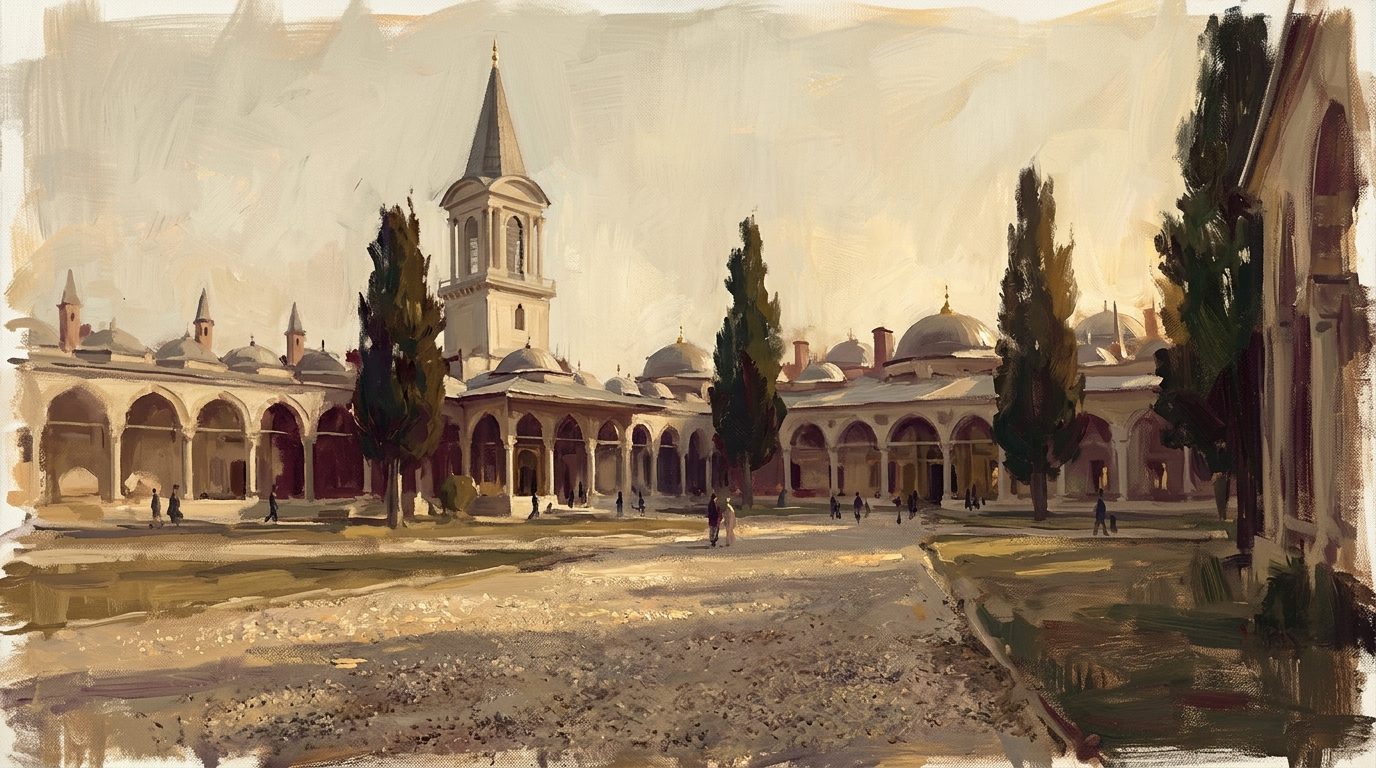
Topkapı Palace architecture is deliberately unlike anything in Europe: not one colossal building but a sequence of walled courtyards, ceremonial gates and modest pavilions, a nomad’s tented camp translated into stone. For around four centuries the Ottoman sultans expressed power here not through mass and symmetry, but through thresholds, seclusion and the slow theatre of approach.
Why Does Topkapı Look Nothing Like Versailles?
Versailles announces power in a single glance: one façade, one axis, one overwhelming mass. Topkapı does the opposite. Begun by Mehmed II in the years after the conquest of Constantinople, it unfolds as a chain of courtyards, each more private than the last, scattered with kiosks and low pavilions rather than dominated by a palace block.
The design remembers where the Ottomans came from. A ruling camp of tents, arranged by rank around the sovereign’s own, became in stone a palace arranged by permission. The further you were allowed to pass, the greater your standing. Grandeur lay not in what everyone could see, but in what almost no one could.
That logic shaped the whole enclosure, from the vast imperial kitchens that fed thousands daily to the Harem folded into the palace’s most secluded corner. Every wall existed to grade access to a single man.
The Three Gates: A Grammar of Power
The sequence opens with the Imperial Gate, the Bab-ı Hümayun, completed under Mehmed II. Its inscription proclaims the sultan master of two continents and two seas, the shadow of God on earth. Before a visitor saw a single courtyard, the stone had already delivered the empire’s argument.
Beyond it rises the Gate of Salutation, the Bab-üs Selâm, with its twin conical-capped towers, the most castle-like image in the whole palace. Here everyone dismounted. Riding through was the privilege of the sultan alone, and the rule admitted no exception, however grand the vizier or foreign prince at the threshold.
The third threshold, the Gate of Felicity, guarded the inner world. Before its domed canopy new sultans were enthroned and the standard entrusted before war. Beyond it lay the sultan’s own realm, the courtyard that also shelters the sacred relics, where entering without summons was unthinkable.
The Tower of Justice and the Sultan’s Hidden Window
Above the Imperial Council hall rises the Tower of Justice, the Adalet Kulesi, the tallest structure in the palace and long a landmark from the sea. Begun under Mehmed II and remodelled repeatedly, it gained its present pointed lantern in the nineteenth century. Its name was a promise: justice watching over the city.
The watching was literal. Inside the council hall, where viziers debated the empire’s business, a golden grille sits high in the wall. Behind it ran a private passage from which the sultan could listen unseen. Ministers never knew whether the eye of the sultan was upon them, and governed as though it always was.
Inside the Arz Odası: The Throne Room of the Empire
Just past the Gate of Felicity stands the Audience Chamber, the Arz Odası, the Topkapı Palace throne room where the empire met the world. Beneath its deep eaves, seated on a canopied and jewelled throne, the sultan received viziers bearing reports and ambassadors bearing letters from distant kings.
An audience here was choreography, not conversation. Envoys were escorted forward by the arms, robed in honour, and presented to a sovereign who rarely spoke, answering instead through his grand vizier. By the entrance a fountain murmured, its water masking voices from any listener outside. Every element of the room was designed to make one man magnificent, silent and unreadable.
What Makes the Library of Ahmed III Special?
In 1719, Sultan Ahmed III raised a white marble library at the centre of the Third Courtyard, one of the loveliest buildings of the Tulip Era. It stands lifted on a low basement to keep damp away from the books, with reading sofas set into windowed bays where light pours across the lattices.
Its holdings ran to thousands of manuscripts in Arabic, Persian and Ottoman Turkish. The building says something telling about the palace: a court that rarely built anything monumental made its exception for books, and even then kept the result small, cool and exquisite rather than vast.
İznik Tiles: The Palace’s Second Skin
If stone gives Topkapı its structure, tiles give it its voice. The İznik workshops clothed the palace in cobalt, turquoise and the celebrated coral red perfected in the sixteenth century, a colour that stands slightly proud of the glaze and has never been convincingly reproduced since.
The Circumcision Room carries some of the finest panels ever fired, including large blue-and-white compositions of an almost calligraphic delicacy. Nearby, the Baghdad and Revan kiosks, built in the 1630s to mark Murad IV’s eastern victories, are tiled inside and out, small pavilions turned into complete ceramic worlds overlooking the water.
A Palace That Refused to Stay Finished
Earthquakes and fires rewrote Topkapı again and again. The great earthquake of 1509 shook the young palace; a fire in 1574 devoured the kitchens, which the architect Sinan rebuilt with the bold ranked chimneys that still define the skyline. Each disaster became an occasion to build differently.
Rebuilding was not an interruption here. It was the architecture’s natural condition, with nearly every sultan adding a kiosk, a chamber or a fountain in the taste of his own age. That is why the palace reads as layers rather than a plan, four centuries of the empire’s story written in one enclosure. Our collection of Topkapı Palace facts gathers more of its surprises.
To read these gates and chambers in person, explore the palace with a guide, entry included.