
The Imperial Treasury of Topkapı Palace
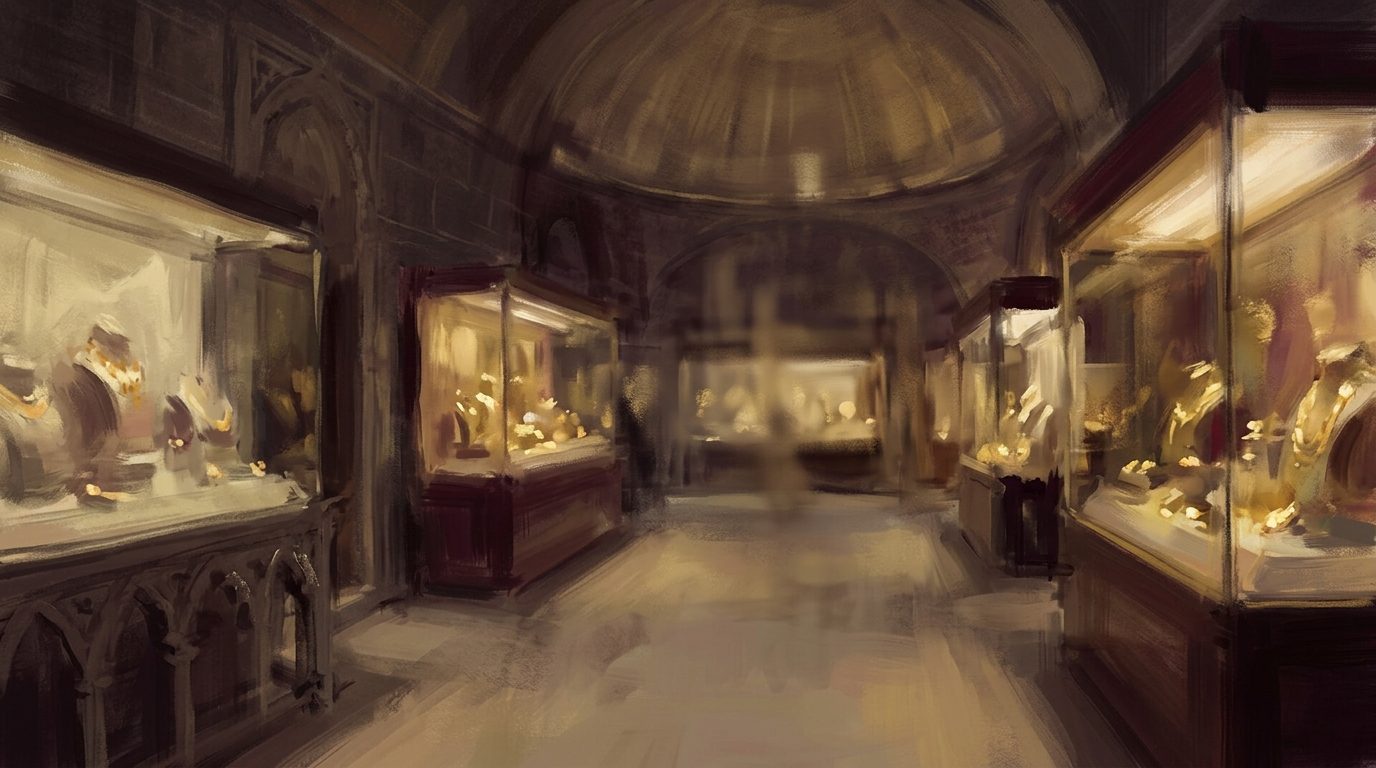
The Imperial Treasury of Topkapı Palace fills four domed rooms of the Conqueror’s Pavilion with the portable wealth of the Ottoman dynasty. Its most famous resident is the Spoonmaker’s Diamond, an 86-carat drop of light ringed by 49 smaller brilliants, followed closely by the emerald-hilted Topkapı Dagger, made in 1747 for a shah who never lived to receive it.
Four Domed Rooms Above the Marmara
The setting matters as much as the contents. The Conqueror’s Pavilion was raised for Mehmed II in the 1460s, which makes it one of the oldest surviving structures in the palace, its arcaded terrace hanging over the Sea of Marmara. From early on, its vaulted chambers served as the dynasty’s strongroom.
Access was ceremonial in itself. The doors were sealed with the sultan’s personal seal, and by tradition each new ruler broke that seal on accession to inspect what his ancestors had gathered. Between such visits the rooms stayed dark and locked, guarded by their own corps of treasury pages. What lay inside was not a museum but a reserve: the dynasty’s insurance policy, rendered in gold and stone.
The Spoonmaker’s Diamond: One Stone, Two Stories
The Treasury’s great celebrity is a pear-shaped diamond of 86 carats, set in silver within a double row of 49 brilliants, so that the whole jewel seems to float in its own halo. How it reached the palace is honestly uncertain, and the two competing tales could hardly differ more.
The Turkish legend gives the stone its name. A rag-picker, so the story runs, found a curious pebble on a refuse heap by the city walls and traded it to a spoon-maker for three wooden spoons; a jeweller’s practised eye did the rest, and word eventually reached the palace. The rival account is French: an officer named Pigot is said to have bought a great diamond in India in the 1770s, after which it passed through auctions and, in one version, through the hands of Napoleon’s own mother before an Ottoman governor acquired it. The records are thin on both sides. We’ve found that the stone keeps its secret rather well, which may be why it draws the longest queues of quiet, craning heads in the palace.
A Dagger for a Murdered Shah
The Topkapı Dagger is the Treasury’s second legend, and its story is better documented. In 1747 Sultan Mahmud I ordered a gift of spectacular richness for Nadir Shah of Persia, part of a diplomatic exchange between two rulers who had spent years at war. Court jewellers set three great cabochon emeralds, each the size of a plum, along the golden hilt, and hid a small watch beneath a hinged emerald lid at the pommel.
The embassy never delivered it. Word reached the travelling party that Nadir Shah had been assassinated by his own officers, and the dagger turned back to Istanbul, an unreturnable gift with no recipient. Two centuries later, Jules Dassin’s 1964 heist film Topkapi built an entire plot around stealing it, and the dagger has enjoyed a second career as cinema’s most famous unstolen object ever since.
Emeralds, Thrones and Aigrettes
Beyond the two headliners, the four rooms hold a court’s whole vocabulary of splendour. The gold-plated Bayram throne, studded with hundreds of green peridots, carried sultans through festival enthronements for three centuries. A jewelled throne of Indian workmanship gleams nearby, a trophy of the same Persian wars that produced the dagger. Display cases hold uncut emeralds the size of a fist, turban aigrettes trembling with diamonds, jewelled armour, ceremonial kaftans and Qur’an bindings crusted in gems.
The effect is deliberate. Ottoman power spoke through objects, and the Treasury was its most concentrated sentence. It stands one courtyard away from the palace’s other great collection, the sacred relics, where the dynasty kept a different kind of wealth altogether.
How Did the Treasury Fill?
Almost nothing here was purchased. The collection grew the way empires grow: through conquest booty, annual tribute, diplomatic gifts from rivals eager to impress, and the estates of dismissed viziers, which reverted to the crown along with their heads. Egyptian tribute alone brought shiploads of gold up the Mediterranean each year.
Just as striking is what never happened. By long custom, objects entered the Treasury and did not leave; even sultans in fiscal crisis melted coin elsewhere before touching the sealed rooms. That habit of accumulation, unbroken across four centuries, is why the collection survives intact where most royal treasuries of Europe were sold, looted or melted. More curiosities from across the palace are gathered in our round-up of Topkapı Palace facts.
To stand before the Spoonmaker’s Diamond yourself, see the palace with a guide, entry included.