
Mehmed the Conqueror & the Founding of Topkapı Palace
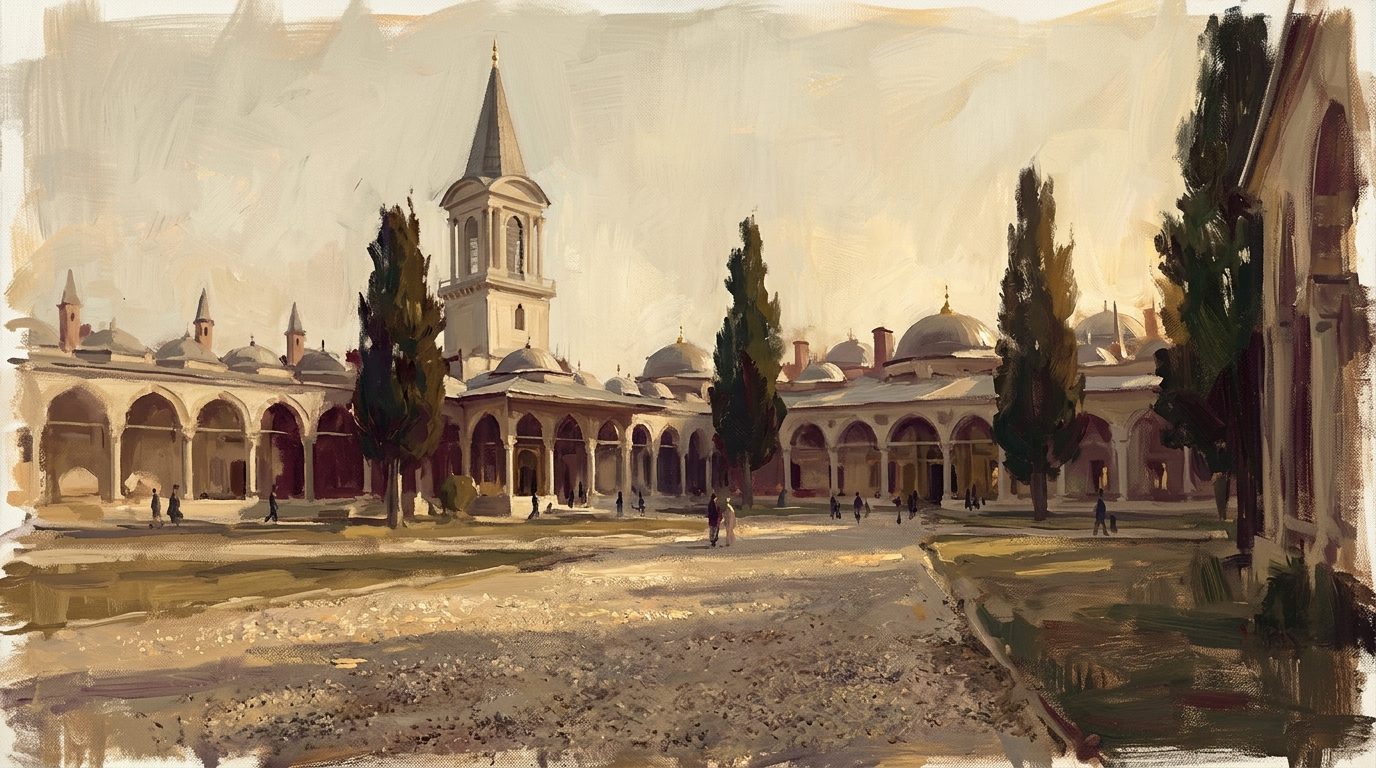
Topkapı Palace was founded by Sultan Mehmed II — Mehmed the Conqueror — who began building it in the 1460s on Seraglio Point, the tip of Istanbul’s historic peninsula where the ancient acropolis of Byzantium once stood. The core of gates and courtyards was largely complete by 1478. Mehmed conceived it not as one grand building but as a sequence of walled courtyards, each more private than the last, so that the palace itself became a machine for staging imperial power.
He was twenty-one when he took Constantinople in 1453, and the city he inherited was half-ruined. The palace he raised there would house his dynasty for almost four hundred years. Its plan still shapes how you move through the site today.
Why Did Mehmed Build a New Palace?
Mehmed’s first palace in his new capital was not Topkapı at all. Soon after the conquest he built the Eski Saray, the Old Palace, on the third hill near what is now Beyazıt Square, where Istanbul University stands. Within a decade he judged it too cramped and too ordinary for the empire he was assembling.
So he turned to the finest site in the city: the promontory above the meeting of the Bosphorus, the Golden Horn and the Sea of Marmara. In antiquity this had been the acropolis of Byzantium, the original Greek settlement that Constantine later refounded as his capital. Mehmed, who styled himself heir to both the Roman and the Islamic imperial traditions, chose the spot with deliberate symbolism. From here his court would command every waterway into the city.
Work on the Saray-ı Cedîd, the New Palace, began in the 1460s. The name “Topkapı” — Cannon Gate — came much later, borrowed from a seaside gate below the walls; if that story interests you, our piece on what the name Topkapı means unpicks it. To Mehmed and his successors, this was always the New Imperial Palace.
An Architecture of Increasing Seclusion
Mehmed’s great innovation was not a façade but a sequence. Rather than one monumental block, he laid out a series of courtyards strung along the ridge, moving from the fully public to the utterly private. Cross a gate, and you entered a more restricted world.
The First Court, entered through the Imperial Gate, was open to the city: service buildings, the mint, the old church of Hagia Eirene used as an arsenal. The Second Court, beyond the Gate of Salutation, held the Imperial Council and the great kitchens, and only those with business at court came this far. The Third Court, past the Gate of Felicity, was the sultan’s own domain — the throne room, the treasury, the palace school — where almost no outsider ever set foot.
This graduated seclusion was itself a statement. Access to the sultan was rationed like a precious resource, and the further in you were admitted, the higher you stood. Silence and distance became the theatre of majesty. The layout you walk today, courtyard by courtyard, is essentially the one Mehmed set down.
What of the Conqueror’s Palace Still Stands?
The core plan is Mehmed’s, though fire and four centuries of additions have reworked much of the detail. The great gates follow his scheme, and the disposition of the courtyards is his. The inscription over the Imperial Gate records completion in the year 883 of the Islamic calendar — 1478 — a firm anchor for when his building campaign had taken shape.
One jewel survives almost intact from his reign: the Tiled Kiosk, the Çinili Köşk, built in 1472 in the outer gardens as a pleasure pavilion. Its Persian-influenced tilework makes it one of the oldest surviving structures on the palace grounds, and today it houses part of the Istanbul Archaeology Museums. Elsewhere, the Treasury occupies a pavilion long associated with the Conqueror himself.
Mehmed also founded the institution that filled these courts: the Enderun, the palace school that trained gifted youths into governors and grand viziers, and the elaborate protocol, the kanunname, that governed court life down to who could speak and when. The buildings staged the power; his rules choreographed it.
The Palace as a Portrait of the Man
Mehmed was a conqueror, but also a collector of cultures. He summoned the Venetian painter Gentile Bellini to Istanbul, who produced a famous 1479 portrait of the sultan; he read in several languages and gathered scholars, astronomers and artists at his court. The palace reflects that breadth — Persian pavilions, a Byzantine site, Islamic protocol, and later Ottoman refinement layered on his frame.
For the daily rhythm that later unfolded inside his courtyards, from the dawn prayer to the silent Harem evening, our account of a day in the life of an Ottoman sultan walks the palace hour by hour.
Standing in the Second Court today, it is worth remembering that a young sultan drew these lines on an emptied acropolis, and that emperors lived by them for four centuries. The palace repays a slow, informed visit; to trace Mehmed’s plan gate by gate with an expert storyteller alongside you, you can arrange a guided visit here.