
The Imperial Council: How the Ottomans Governed from the Divan
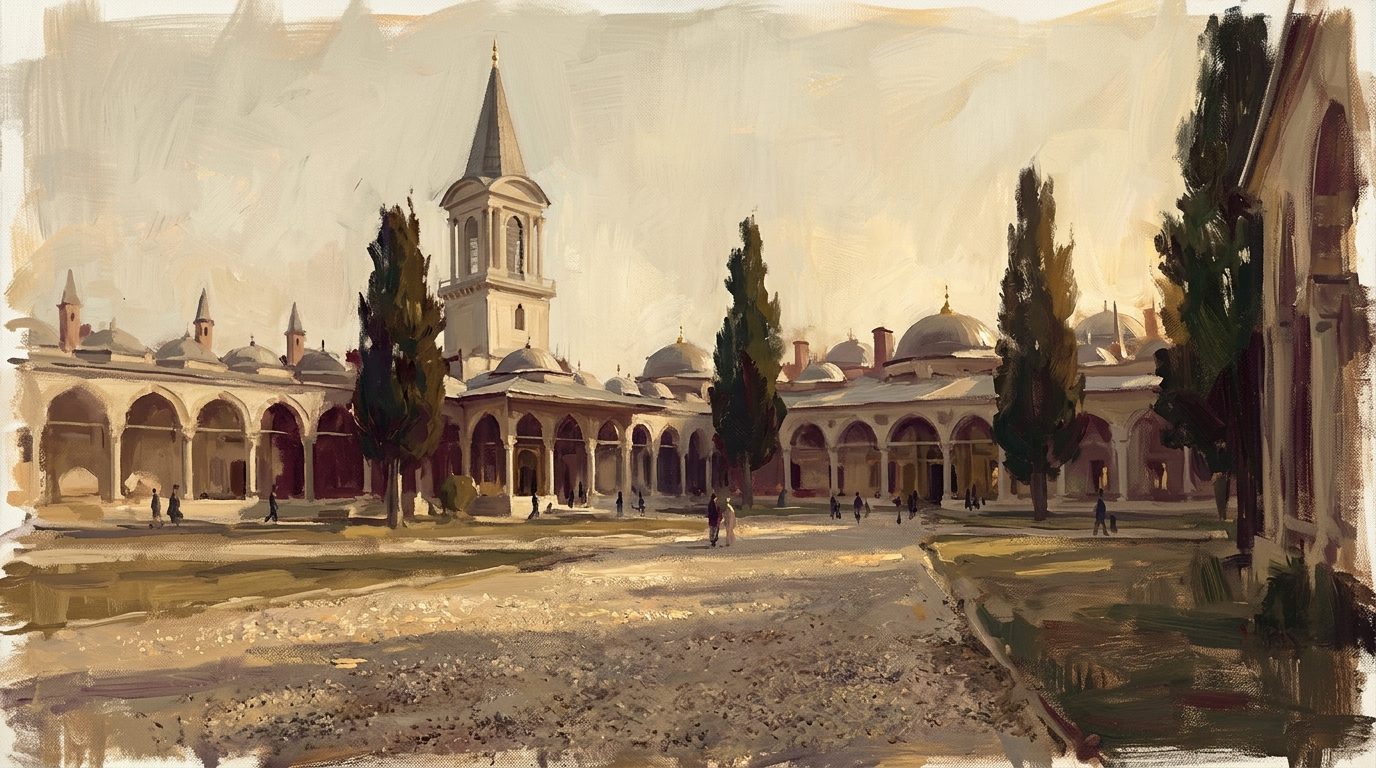
The Ottoman Empire was governed day to day from the Imperial Council, the Divan-ı Hümâyun, which met in a domed hall in Topkapı’s Second Court beneath the Tower of Justice. There the grand vizier and his fellow ministers heard petitions, judged disputes, appointed officials and planned wars — while, from the reign of Mehmed II onward, the sultan himself watched unseen through a gilded grille in the wall above their heads.
It is one of the most revealing spaces in the palace: the room where an empire spanning three continents was actually run. Here is how it worked.
What Was the Divan?
The Divan-ı Hümâyun was the empire’s central council of state, part cabinet and part supreme court. In the classical period it met four days a week in the Kubbealtı, the chamber “under the dome” on the western side of the Second Court, its arcades opening onto the courtyard.
Its members were the great officers of the empire. At their head sat the grand vizier, the sultan’s absolute deputy, who carried the imperial seal. Beside him sat the other viziers, the two kazaskers or chief military judges who oversaw law and religious courts, the defterdars who controlled the treasury, and the nişancı who authenticated documents with the sultan’s monogram, the tuğra. Between them these men held the administrative, financial, judicial and military threads of the state.
Justice in the Open
The Council’s most striking feature was its openness to petition. In principle any subject of the empire — a soldier, a merchant, a villager with a grievance against a governor — could bring a complaint before the Divan and expect a hearing. Cases were heard, disputes settled, and appointments confirmed in sessions that mixed high policy with individual justice.
This was the practical meaning of the Tower of Justice, the tall spire rising directly above the Council hall and visible far across the city. Its message was deliberate: the sultan’s justice stands over the whole empire and sees everything. The tower was both a symbol and, from its upper windows, a genuine vantage point over the courtyards below.
The Eye of the Sultan
Early sultans presided over the Council in person. Mehmed the Conqueror changed that, withdrawing the sovereign from the daily grind of debate — a decision that reshaped Ottoman government for centuries.
In his place he left a device of pure political theatre. Set high in the wall of the Council chamber, reached from the private apartments behind, was a gilded latticed window known as the kasr-ı adl — the “Eye of the Sultan”. Behind it the ruler could sit and listen, entirely unseen. The viziers debating below could never be certain whether the grille was empty or whether their master was, at that very moment, weighing their words. That uncertainty was the whole point: it kept the most powerful men in the empire honest, or at least careful. The same grille appears in our account of a day in the life of an Ottoman sultan.
Pay Day and the Ambassadors
The Council chamber sat on the same courtyard as the great imperial kitchens, and on certain days the Second Court filled with ceremony. On the quarterly pay days the janissaries assembled to receive their wages in coin, counted out in the courtyard — a ritual watched anxiously by the court, since a regiment that refused its pay was a regiment close to revolt.
Foreign ambassadors were often received on these same days, timed so that the envoy witnessed the disciplined ranks and the heaps of silver as a display of Ottoman wealth and order. After the Council rose, the grand vizier would report its business to the sultan in the Arz Odası, the Chamber of Petitions just inside the Gate of Felicity, and important guests were presented there before the throne.
Reading the Room Today
Stand in the Second Court now, look up at the Tower of Justice, and you are looking at the address from which laws issued and wars were declared. The domed Council hall, the grille, the throne room beyond the gate — together they form a diagram of how the Ottomans balanced a visible bureaucracy against an invisible sovereign.
These spaces make far more sense with their workings explained on the spot — who sat where, what the grille meant, how a petition travelled. To walk the seat of Ottoman government with an expert guide, you can arrange a guided visit here.