
20 Fascinating Facts About Topkapı Palace
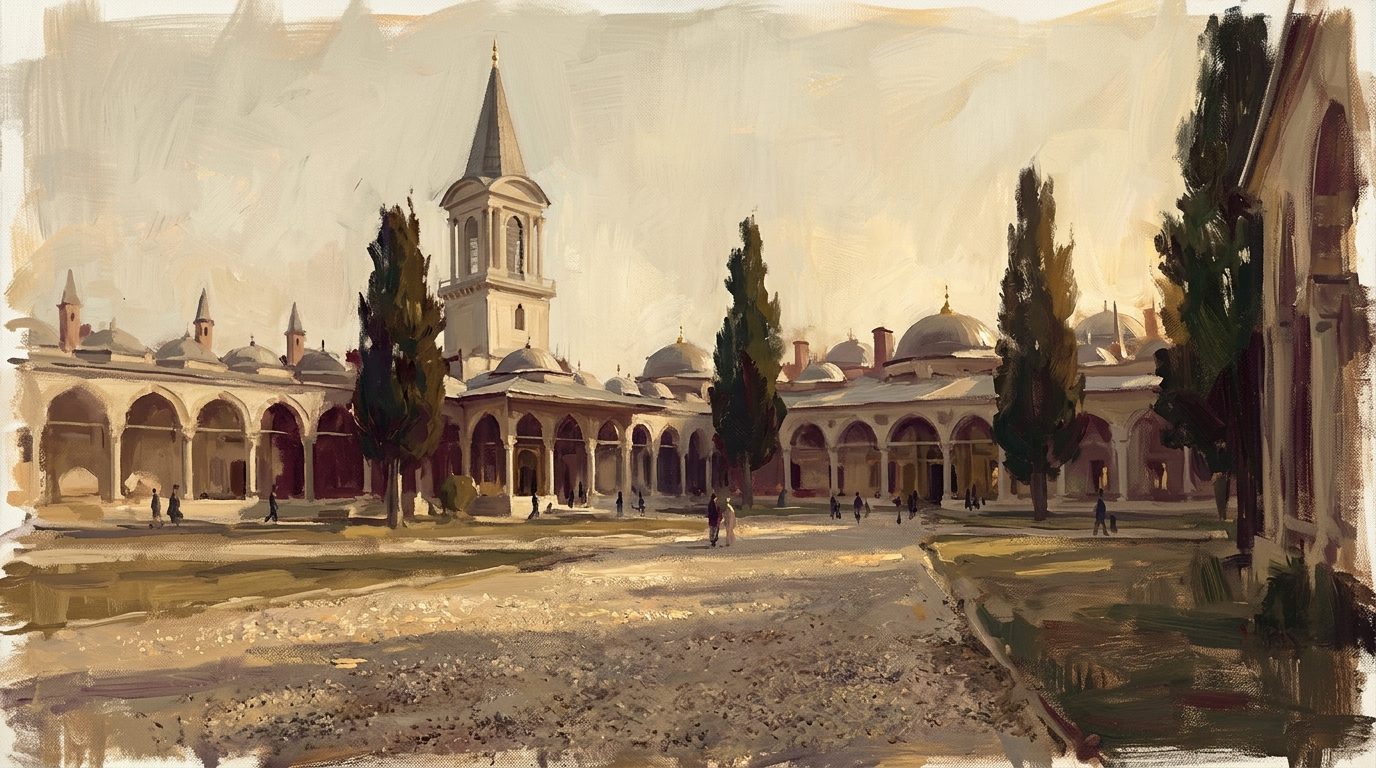
Topkapı Palace was the nerve centre of the Ottoman Empire for around four centuries, home to roughly 30 sultans and, at its height, thousands of residents. Behind its walls lie caged princes, a diamond traded for spoons, gardeners who doubled as executioners, and a recitation that has barely paused since the sixteenth century.
Think you know this palace? The details are stranger than any fiction. Here are twenty facts worth carrying with you through its courtyards.
20 Facts That Reveal the Palace’s Hidden World
1. It ruled an empire for around four centuries
From the 1460s, when Mehmed the Conqueror raised it on the first hill of his new capital, until 1856, Topkapı was the administrative heart of the Ottoman Empire. Laws, wars, treaties and successions all flowed from this single walled promontory above the meeting of three waters.
2. Roughly 30 sultans called it home
Of the 36 sultans who ruled the Ottoman Empire across six centuries, around 30 lived and governed at Topkapı. Each left a mark: a pavilion, a fountain, a library, a fire’s scars repaired. The palace grew by accretion, which is why it feels like a village rather than a single building.
3. The name means ‘Cannon Gate’
“Topkapı” combines the Turkish top, cannon, and kapı, gate. The name belonged to a cannon-flanked gate in the Byzantine sea walls below the palace, beside a wooden shore pavilion. When that pavilion burned, its everyday nickname had already spread uphill to the whole complex. Officially, the Ottomans called it the New Imperial Palace.
4. It was a walled city in miniature
Topkapı wasn’t merely a residence but a self-contained town: mint, hospital, bakeries, mosques, dormitories, workshops and a school for civil servants. At its peak the population within the walls numbered in the thousands, from pages and cooks to falconers, dwarves, mutes and the imperial guard.
5. The Harem holds around 300 rooms
The Harem was no single chamber but a labyrinth of around 300 rooms, courtyards and baths, ruled in practice by the sultan’s mother, the valide sultan. It was a strict institution with its own hierarchy, wages and schooling, worlds away from the languorous fantasy painted by European artists.
6. Princes were confined in the ‘Golden Cage’
From the early seventeenth century, the old practice of royal fratricide gave way to the kafes, or Golden Cage: secluded Harem apartments where the sultan’s brothers and heirs lived under guard, sometimes for decades. Several emerged to take the throne with almost no experience of the world outside.
7. Its great diamond was allegedly swapped for three spoons
The 86-carat Spoonmaker’s Diamond, star of the Treasury, owes its name to a legend: a fisherman found a glassy pebble in a rubbish heap and traded it to a spoonmaker for three wooden spoons. However it truly arrived, it remains one of the largest cut diamonds on earth.
8. The Topkapı Dagger was a gift that never arrived
In 1747 Sultan Mahmud I sent a spectacular emerald-studded dagger to Nadir Shah of Persia. The shah was assassinated before the envoys arrived, so the gift came home. Two centuries later, the 1964 heist film Topkapi made the dagger an international star, and won Peter Ustinov an Oscar.
9. The Qur’an has been recited here for centuries, around the clock
After Sultan Selim I brought the holy relics of Islam to Istanbul in 1517, recitation of the Qur’an began beside them in the Chamber of Sacred Relics. That recitation has continued, hour after hour, with scarcely an interruption for roughly five hundred years. It still sounds today.
10. The kitchens fed around 5,000 people a day
The palace’s imperial kitchens, a row of ten domed halls with soaring chimneys, employed a small army of cooks. On ordinary days they fed around 5,000 people; on feast days, far more. The scale of provisioning, from Black Sea butter to Egyptian rice, shaped whole trade routes.
11. The porcelain was chosen to ‘detect poison’
Topkapı holds one of the world’s great collections of Chinese celadon porcelain, prized at court for a very practical reason: it was believed to change colour or crack on contact with poison. For a dynasty that lived with the threat of intrigue, dinnerware doubled as a security system.
12. The gardeners were also the executioners
The bostancı corps kept the palace’s grounds and orchards, rowed the sultan’s barge, and carried out executions. The same hands that pruned roses could deliver a death sentence. Their chief, the bostancıbaşı, was among the most feared officials in the empire.
13. The Tower of Justice was built to watch and be seen
The pointed Tower of Justice rises above the whole palace, visible from far across the city. Its message was deliberate: the sultan’s justice sees everything. From its heights, and from windows below, the sovereign could quietly observe the machinery of his own government.
14. The sultan eavesdropped on his ministers through a golden grille
The Imperial Council met beneath the tower, and set into the wall above the ministers’ heads was a gilded lattice window called the “Eye of the Sultan”. The sultan could listen unseen behind it. Ministers debated never knowing whether the empire’s master was, at that moment, listening.
15. Ahmed III threw legendary tulip festivals
During the so-called Tulip Era of the early eighteenth century, Sultan Ahmed III staged nighttime garden festivals where tulips bloomed by the tens of thousands, lamps flickered among the flowers, and tortoises wandered the beds carrying candles on their shells. Extravagance, in the end, helped cost him his throne.
16. Sultans were never crowned, they were girded
No Ottoman sultan wore a crown. Accession was marked by girding the Sword of Osman, the dynasty’s founder, at the mosque of Eyüp up the Golden Horn, followed by ceremonies at the palace’s Gate of Felicity, where the new sovereign received homage on a golden throne.
17. The court left for Dolmabahçe in 1856
After almost four hundred years, Sultan Abdülmecid I abandoned Topkapı for the new Dolmabahçe Palace on the Bosphorus, a gilded, European-style residence with gas lighting and a French designer’s flourish. Topkapı slipped into quiet dignity, kept mainly for the relics and ceremonies of state memory.
18. It became a museum in 1924
On 3 April 1924, by order of the young Turkish Republic under Atatürk, Topkapı opened as a museum, among the first of the new state. Rooms once forbidden to all but a handful of people in the world became, almost overnight, open to anyone with curiosity.
19. Mimar Sinan rebuilt the kitchens after a great fire
When fire tore through the palace in 1574, the great architect Mimar Sinan, builder of the Süleymaniye Mosque, rebuilt and enlarged the kitchens. His ten pairs of domes and monumental chimneys still define the palace’s silhouette from the sea, a masterpiece devoted entirely to cooking.
20. The whole palace is a UNESCO treasure
Topkapı is inscribed on the UNESCO World Heritage List as part of the Historic Areas of Istanbul, listed in 1985 alongside Hagia Sophia and the city’s ancient walls. It is recognised not just as a building but as the surviving stage set of an entire civilisation.
Twenty facts barely scratch the surface; every courtyard hides another story. To hear them told where they actually happened, in front of the grilles, daggers and domes themselves, a guided visit with an expert guide is the richest way in, and you can arrange one here.